The Science Behind Soft Shell Crab Production
Understanding the molting process, the critical harvest window, and how modern RAS technology enables consistent, scalable production.
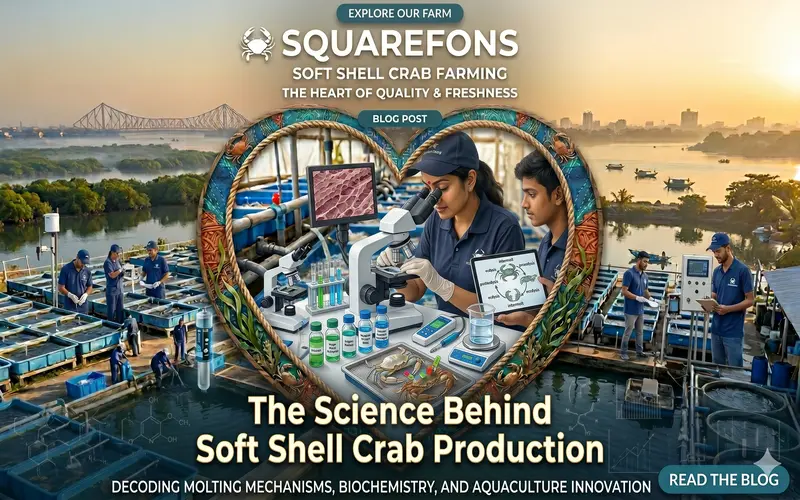
Soft shell crab production is a fascinating intersection of biology, timing, and technology. Unlike traditional aquaculture where animals are harvested at maturity, soft shell crab farming requires harvesting at a precise biological moment.
The Molting Process
Crabs grow by periodically shedding their hard exoskeleton in a process called molting or ecdysis. During molting, the crab absorbs water to swell its body, causing the old shell to crack along predetermined fracture lines. The crab then backs out of its old shell, emerging with a soft, wrinkled new shell.
This new shell is about 80% water and contains no calcium — making it completely soft and edible. Over the next 4-24 hours, the shell begins to harden as the crab deposits calcium. The critical harvest window is only 4-5 hours.
Our Production System
Square Fons employs a multi-stage production system:
- Hatchery — Broodstock are maintained in controlled conditions. Larvae progress through zoea, megalopa, and crab instar stages over 3-4 weeks.
- Nursery — Crablets are grown to 60-100g in earthen ponds.
- Grow-Out — Crabs are transferred to individual vertical boxes or pond culture systems.
- Molting Facility — 24/7 monitoring with inspections every 4 hours.
RAS Technology
Our Recirculating Aquaculture Systems maintain optimal water quality through:
- Mechanical filtration (sand filters)
- Biological filtration (biofilters)
- UV sterilization
- Protein skimmers
- Temperature control
This technology reduces water usage by up to 90% compared to traditional pond farming and ensures consistent water quality year-round.